A framing contractor has been buying from your yard for three years. Lumber, sheathing, hardware with consistent volume and a good relationship. His rep would tell you the account is solid. What nobody has checked is whether he has ever been quoted on roofing, doors, or windows. That business has been going somewhere else for three years, and it never showed up as a problem because nothing flagged it.
That is the cross-sell gap. It is not a failed relationship. It is a coverage problem and it is happening across your book of business right now.
Why gut feel alone doesn't cut it
Reps know their top accounts well. They know which categories those contractors buy, roughly what they spend, and when something feels off. For the top 15 or 20 accounts in a territory, that instinct is usually right.
Beyond that, the picture gets unreliable fast. A rep managing 60 accounts cannot hold the full category history of every contractor in their head. Mid-tier accounts, the ones doing $30k or $40k a year, stay active enough that nobody worries about them, but not prominent enough that anyone is systematically asking what categories they are and are not buying.
Managers try to close this gap with quarterly account reviews. But quarterly reviews confirm what already happened. By the time a report shows a contractor has never bought trusses from you, that contractor may have been buying trusses from a competitor for two years. The gap existed the whole time. The report just makes it visible too late to do much about it.
The data problem underneath the coverage problem
Most LBM dealers running on BisTrack or a comparable ERP have category-level transaction history sitting in their system already. In theory, that data should tell you exactly which accounts have gaps worth pursuing. In practice, getting to that insight requires clearing a few obstacles that most yards have not solved.
The first is category structure. Some dealers have clean product categories already defined in their ERP. Others have messier data, products that are not consistently categorized, special order items that fall outside the standard hierarchy, or category definitions that do not map cleanly to how the sales team thinks about the business.
The second is job address fragmentation. A single job might generate 10 or more separate quotes in the ERP with no connection between them. Framing, sheathing, and hardware can show up as separate line items under different quote numbers for the same address. Without grouping those quotes by job, you cannot see which categories have and have not been sold to a given project.
The third is quoting system separation. Windows, trusses, and other engineered products often run through a separate manufacturing quote system that does not connect to the main ERP. That means the ERP alone gives you an incomplete picture. A contractor who sources trusses from you might not show that in the same place as their framing history, which makes the account look like a cross-sell opportunity when it is not.
How SalesJack surfaces cross-sell gaps automatically
SalesJack's CRM pulls transaction history from your ERP and runs it through a data transformation layer built specifically for building materials sales. Category mapping is handled during implementation using product groups, departments, and classes already in your ERP, with special order items mapped in as well. Dealers with clean category structures get full coverage from day one. Those with messier data get help cleaning it up before the system goes live.
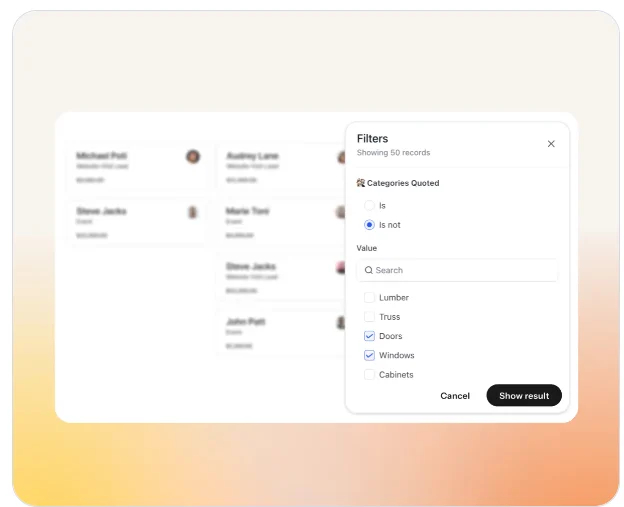
Job address grouping is built in. SalesJack connects quotes and transactions across a single address automatically, so reps see which categories have been sold to each job and where the gaps are, not 12 disconnected line items under the same contractor.
For windows, trusses, and other engineered products that live in a separate quoting system, SalesJack can integrate that data alongside ERP history. The rep gets a complete view of account activity in one place instead of having to cross-reference two systems to understand what a contractor has and has not bought.
When a gap exists, SalesJack flags it and routes the alert to the right rep automatically. That alert goes out for every account with a gap, not just the top accounts already on a rep's radar. The contractor buying framing and doors but not roofing shows up as a cross-sell opportunity for the OSR or specialty category rep responsible for that product line, without anyone having to go looking for it.
What each role gets from this
Reps get visibility into category gaps across their full book of business, with alerts routed to them when an opportunity exists. They know which accounts to call and what to ask about, with the category history to back it up. SalesJack's marketing tools also let reps send targeted email and text campaigns directly to accounts with identified gaps, so outreach can happen at scale without manual coordination.
Managers see cross-sell activity and conversion rates across the team through the Analytics dashboard: which reps are following up, which categories are being expanded, where penetration is low. That turns coaching conversations from directional to specific.
Owners and GMs see wallet share trends by account and by category across the whole business. How much of total addressable spend from existing customers is actually being captured? Where are the biggest gaps by revenue potential? That visibility makes cross-selling a trackable growth lever, not a rep-by-rep effort. See how dealers like PARR Lumber and Evanston Lumber are using SalesJack in the case studies.
What a generic CRM gets you instead
HubSpot and Salesforce can store transaction data. They cannot do what is described above. The logic to identify cross-sell gaps in LBM product categories does not come with either platform. Building it requires understanding how building materials dealers structure ERP data, how to connect a separate quoting system for trusses and windows, and how job address grouping works across a quote history. Most retailers and agencies implementing general-purpose CRMs do not arrive knowing any of that. You pay for their learning curve before they can build anything useful and what they build needs ongoing maintenance every time your ERP or category structure changes.
SalesJack has all of this built in because it was designed for this specific problem.
See what category gaps exist across your book
SalesJack integrates with building materials ERPs including Epicor, ECI, DMSI, Genetiq, and Ponderosa, and maps your product categories during implementation so cross-sell identification works from day one. Implementation takes 4 to 6 weeks including ERP integration, category mapping, quoting system setup, and on-site training.
Book a demo to see how cross-sell gap identification works for your specific ERP and territory structure, or use the Contact page to discuss where category gaps are costing you the most revenue.
Bottom line
Cross-selling breaks down in lumberyard sales for a predictable reason: the data exists in your ERP, but there is no system to turn it into alerts for the right rep at the right time. Category gaps persist across mid-tier accounts for years because nobody is systematically looking for them.
Solving it requires clean category mapping, job address grouping across fragmented quote data, integration with separate quoting systems, and automated routing when a gap is found. That is the difference between cross-selling as a rep habit and cross-selling as a process.
For more on how building materials dealers use data to grow revenue from existing accounts, check out the SalesJack blog.